Forests & climate
Carbon uptake, hydroclimatic stress and the resilience of tropical ecosystems.
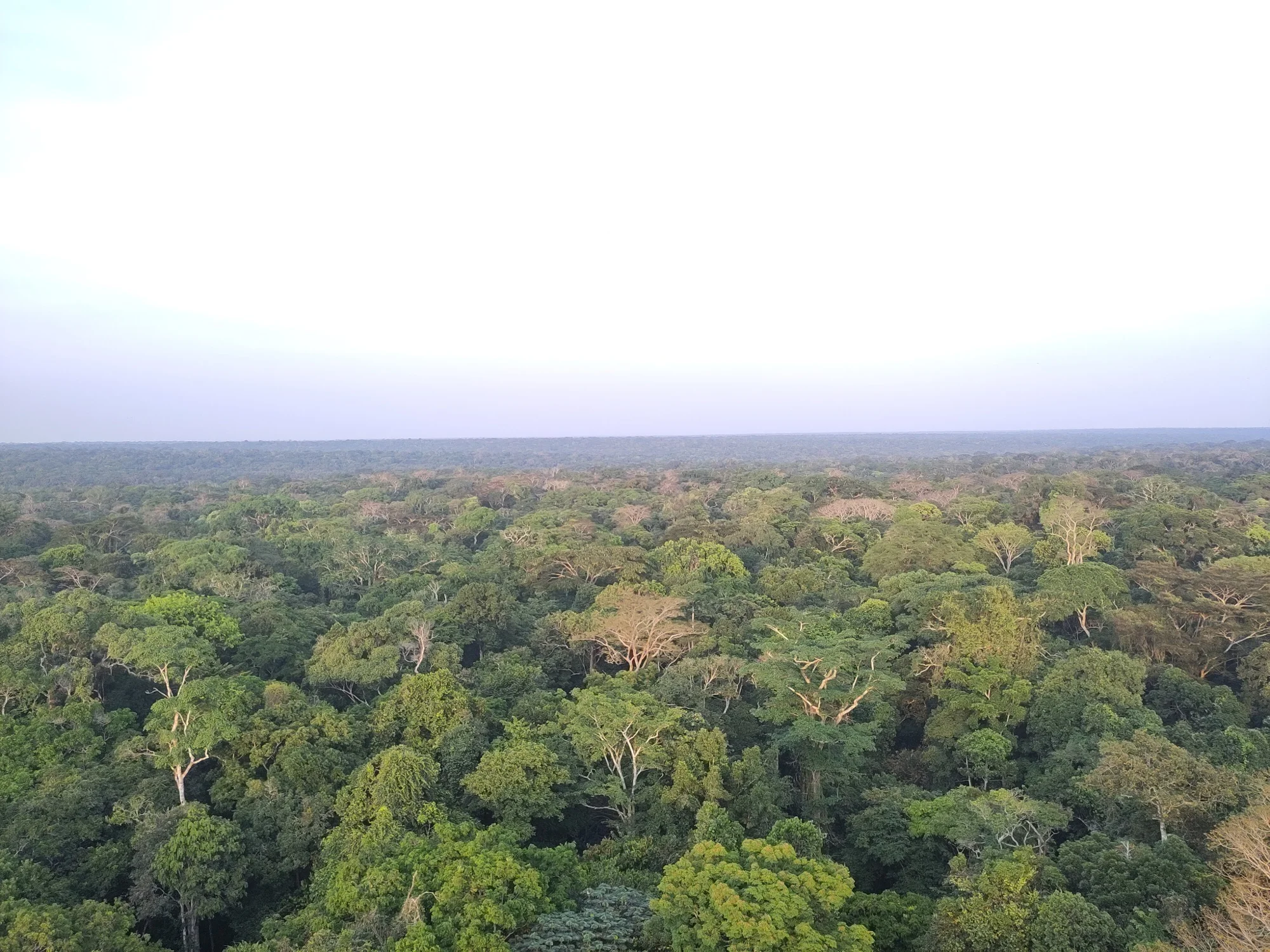
I connect field observations, remote sensing and ecosystem models to understand how tropical forests respond to a changing climate.
Explore my research ↗Download CV (PDF) ↓How resilient are tropical forests to climate change—and what does their future mean for our planet?
I am a vegetation modeller working at the intersection of tropical forest ecology, climate science and artificial intelligence. My background in environmental sciences and physics shapes how I approach ecological questions: by connecting the mechanisms inside individual plants with the behaviour of whole ecosystems.
My research focuses on the Amazon and Congo Basin, where climate change, land-use change and disturbance interact. I combine field observations, satellite data and process-based models to investigate forest productivity, recovery, plant water use and the role of lianas. I want to understand where forests can remain resilient, where they may approach critical thresholds, and which observations can most improve our predictions.
Carbon uptake, hydroclimatic stress and the resilience of tropical ecosystems.
Connecting forest structure, plant traits and remote sensing with predictive models.
Understanding how climbing plants reshape competition, canopy structure and carbon storage.
My doctoral work explored soil–plant water relations through functional–structural models. Alongside my PhD in Environmental Sciences, I completed a master’s degree in Physics, building the mathematical foundation for my later work on ecosystems and climate.
At Ghent University, my research expanded from plant hydraulics to tropical forest dynamics. A two-year stay at Boston University strengthened my work in ecological forecasting and model–data integration. FWO junior and senior postdoctoral fellowships supported research on lianas and the resilience of Congo Basin forests.
Within B-Climate / HYDR, I investigate forest responses to climate and land-use change. My current direction combines process-based ecosystem models with machine learning to develop faster, observation-constrained tools for exploring forest futures.
The future of tropical forests calls for an integrated approach.
I connect new observations with mechanistic understanding, particularly in regions where environmental data remain scarce. Three-dimensional forest measurements, climate records and satellite observations help reveal where models succeed, where they fail, and which processes are missing.
I am developing hybrid modelling approaches that combine the physical foundations of land-surface models with the speed and flexibility of AI. The goal is to explore climate and land-use scenarios while making uncertainty explicit.
I work across ecology, climate science and quantitative methods, connecting Belgian and international researchers with partners in Central Africa. These collaborations bring complementary expertise to shared questions and strengthen local capacity in environmental observations and modelling.
In teaching and supervision, I connect theory with hands-on research: interactive lectures, Python and R notebooks, field data, model development and independent projects. I value personal mentoring, joint research projects and hackathons that help students and colleagues learn from one another.
Download my CV (PDF) ↓